What Is AIWAY OS — And Why Most Organizations Don’t Need It (Yet)
A clear-eyed explanation of what AIWAY OS is, what problem it solves, and why deploying it before the conditions are right is its own kind of mistake.
There’s a moment in every maturing AI program when the conversation shifts.
It stops being about which tools to adopt. It starts being about how to operate what you’ve already built.
That shift sounds straightforward. In practice, it’s where most AI investments quietly begin to fragment.
AI at scale creates a different problem
Early AI adoption is fundamentally a selection problem. Which tools? Which vendors? Which use cases?
But as AI initiatives grow and multiply, a structural challenge emerges. Systems built at different times, by different teams, with different assumptions now need to work together. And nobody designed them to.
The symptoms are predictable — fragmented workflows, inconsistent governance, rising operational costs, AI that works in isolation but creates friction everywhere else.
This isn’t a technology failure. It’s an architecture failure.
What AIWAY OS actually is
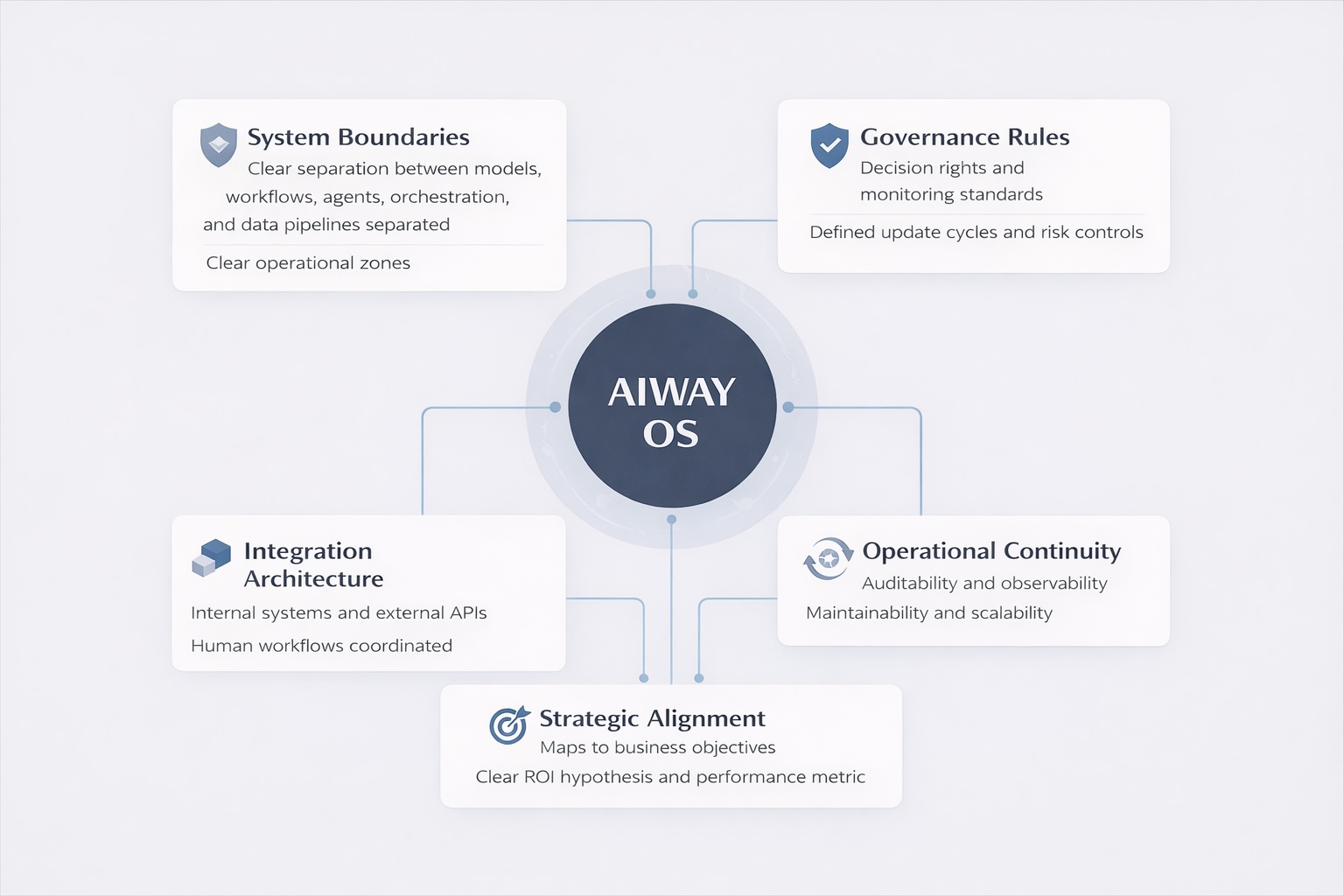
Let’s be direct: AIWAY OS is not a product. It’s not a platform you license. You can’t buy it.
AIWAY OS is a proprietary architectural framework — a structured operating layer we deploy selectively in complex AI environments. It defines how AI systems interact, how they’re governed, and how they remain aligned with business objectives as they scale.
Specifically, it addresses five things:
System boundaries. Clear separation between models, data pipelines, workflows, and business logic — so changes in one don’t destabilize others.
Governance rules. Decision rights, monitoring standards, update cycles, and risk controls — defined in advance, not invented under pressure.
Integration architecture. How AI components interact with internal systems, external APIs, and human workflows — designed for longevity, not just for the immediate use case.
Operational continuity. Auditability, observability, maintainability, and scalability — not added later, but built into the architecture from the start.
Strategic alignment. Every AI system maps to a business objective, a performance metric, and a clear ROI hypothesis. No orphan projects. No experimentation drift.
The goal is not sophistication. The goal is coherence — AI that operates like infrastructure, not like a collection of experiments.
Infrastructure scales. Experiments accumulate.
Most organizations don’t need it
That’s not a disclaimer. It’s the point.
AIWAY OS was designed for a specific set of conditions:
- Multiple AI systems operating in the same environment
- Custom integrations that require architectural continuity
- Long-term governance and compliance requirements
- Scale of operations where operational overhead is materially significant
For organizations in early-stage AI adoption, this level of architecture is overhead — and expensive overhead at that. The right investment at that stage is clear strategy and the right first implementations. Not an operating framework for systems that don’t yet exist.
When complexity grows, that calculation changes.
When it becomes relevant
AIWAY OS is deployed when:
- AI is mission-critical, not exploratory
- The scale of operations justifies a structured operating model
- Leadership is building for long-term control, not short-term output
- Senior-level architectural oversight is both necessary and sustainable
In practice, this typically describes mid-to-large technical organizations — engineering firms, B2B companies, technical consultancies — that have moved past the experimentation phase and are treating AI as operational infrastructure.
It’s not a starting point. It’s what becomes necessary when the starting point has succeeded.
Why we don’t offer it broadly
Because architecture without need is just cost.
These engagements require direct senior involvement — in design, in implementation and in production deployment. That limits how many we can run at any given time. We limit them deliberately.
The organizations that benefit most aren’t looking for something sophisticated. They’re looking for something durable.
The question that eventually surfaces
As AI matures inside organizations, the question shifts from “what should we build?” to “how do we operate what we’ve built?”
That is a systems question. And systems require operating models.
AIWAY OS is our answer — deployed selectively, when the conditions are right, and when the work of building it is clearly worth doing.
AI is not a tool decision. It is a strategic positioning decision.
Let's clarify yours.
Structured process. Limited availability.